
Mfg Part Number
QBD-10786-100
Vector Labs QBD-10786-100 Biotin-dPEG®₂₃-NH₂ - 100 mg (1/EA)
Quick Overview
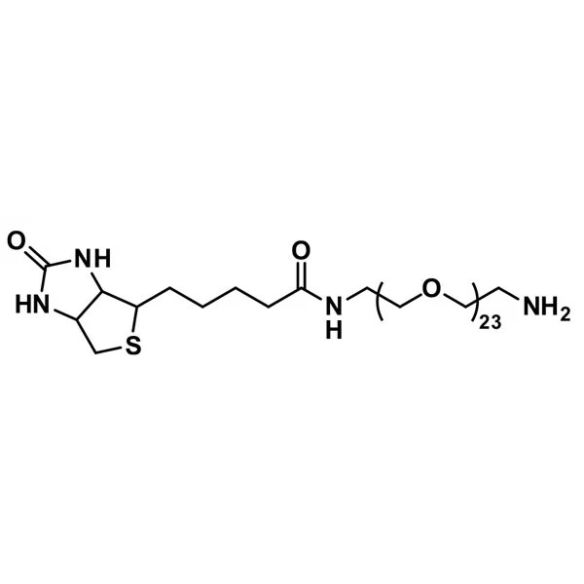
Biotin-dPEG₂₃-NH₂
$363.44
Order will ship within 1-3 business days
Biotin-dPEG®23-NH2 (Biotin-dPEG®23-amine), product number QBD-10786, is a carboxylate-reactive biotinylation product on a long (71 atoms), single molecular weight, discrete PEG (dPEG®) spacer. Biotin-dPEG®23-NH2 reacts with activated esters (N-hydroxysuccinimide, 2,3,5,6-tetrafluorophenyl) of carboxylic acids under slightly basic conditions. Moreover, it can be coupled directly to a carboxylic acid using 1-Ethyl-3-(3-dimethylaminopropyl)carbodiimide (EDC) chemistry. Additionally, the product reacts with aldehydes or ketones to form a labile Schiff base. The Schiff base can be reduced to a secondary amine using sodium cyanoborohydride if additional conjugate stability is necessary.
Amphiphilic Biotin-dPEG®23-NH2 dissolves equally well in both aqueous media and organic solvents. Therefore, it is unnecessary to dissolve this product in an organic solvent before using it in an aqueous reaction. Furthermore, biotinylation of biomacromolecules with Biotin-dPEG®23-NH2 will not cause aggregation and precipitation. Eliminating aggregation and precipitation improves the signal-to-noise ratio of applications developed with this product. Reactions with carboxylic acids or active esters of carboxylic acids yield stable amide bonds. Aldehydes are not commonly found in biomacromolecules but can be formed by oxidizing reducing sugars in glycosylated proteins. Reactions with aldehydes create labile imines (Schiff bases) that can be reduced under mild conditions with sodium cyanoborohydride to form more stable secondary amines. Biotin-dPEG®23-NH2 works in any application that can take advantage of the exceptionally strong biotin-avidin/streptavidin affinity. The terminal amine of QBD-10786 offers the opportunity (1) to biotinylate the carbohydrate coat of glycoproteins by oxidizing reducing sugars to aldehydes and (2) to biotinylate surfaces consisting of carboxylic acids or their active esters. Thus, this product expands the range of molecules and nanoparticles in which dPEG®-biotin can be employed.
Amphiphilic Biotin-dPEG®23-NH2 dissolves equally well in both aqueous media and organic solvents. Therefore, it is unnecessary to dissolve this product in an organic solvent before using it in an aqueous reaction. Furthermore, biotinylation of biomacromolecules with Biotin-dPEG®23-NH2 will not cause aggregation and precipitation. Eliminating aggregation and precipitation improves the signal-to-noise ratio of applications developed with this product. Reactions with carboxylic acids or active esters of carboxylic acids yield stable amide bonds. Aldehydes are not commonly found in biomacromolecules but can be formed by oxidizing reducing sugars in glycosylated proteins. Reactions with aldehydes create labile imines (Schiff bases) that can be reduced under mild conditions with sodium cyanoborohydride to form more stable secondary amines. Biotin-dPEG®23-NH2 works in any application that can take advantage of the exceptionally strong biotin-avidin/streptavidin affinity. The terminal amine of QBD-10786 offers the opportunity (1) to biotinylate the carbohydrate coat of glycoproteins by oxidizing reducing sugars to aldehydes and (2) to biotinylate surfaces consisting of carboxylic acids or their active esters. Thus, this product expands the range of molecules and nanoparticles in which dPEG®-biotin can be employed.
| Brand | Vector Labs |
|---|---|
| UNSPSC | 12161700 |
| Reagent Application | Bioconjugation |
| Reagent Size | 100 mg |