
Mfg Part Number
QBD-11102-1000
Vector Labs QBD-11102-1000 Biotin-dPEG®₁₁-oxyamine. HCl - 1000 mg (1/EA)
Quick Overview
Biotin-dPEG₁₁-oxyamine. HCl - 50 mg
$1,510.43
Order will ship within 1-3 business days
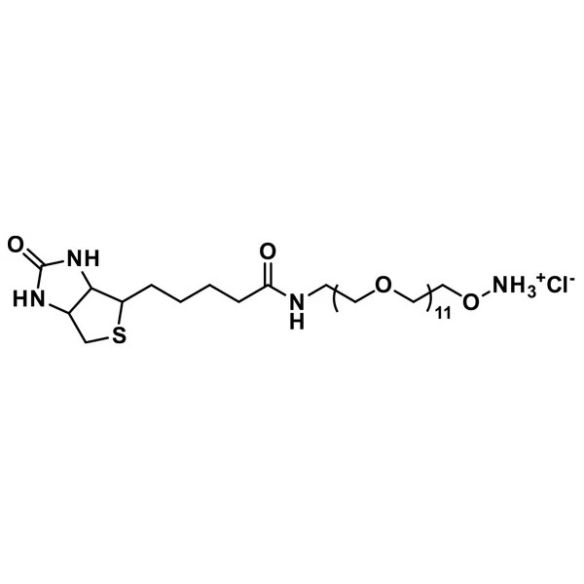
Biotin-dPEG®11-oxyamine·HCl, product number QBD-11100, consists of a medium-length (38 atoms, 44.9 Å) single molecular weight, discrete PEG (dPEG®) spacer functionalized at each end with biotin and an oxyamine group (as the HCl salt), respctively. This PEG biotin compound reacts with aldehydes and ketones to forms stable oxime bonds. Using this biotinylation reagent permits biotin labeling of the carbohydrate coats of glycoproteins after the introduction of aldehydes and ketones on the carbohydrate coat using enzymatic (for example, galactose oxidase) or mild chemical reaction conditions such as sodium periodate.
Biotinylation is the process of covalently attaching biotin to a molecule such as a peptide, protein, or nucleic acid, or surfaces such as glass or gold. Bioconjugation research and product development and numerous clinical assays use biotinylated molecules. The amphiphilic dPEG® linker of Biotin-dPEG®11-oxyamine·HCl imparts excellent water solubility to biotin, which is usually poorly soluble in water and causes non-specific hydrophobic interactions when conjugated to biomolecules.
Some commercially available biotin-aminooxy products use either no spacer or a hydrophobic alkyl chain as a spacer between biotin and the aminooxy moiety. Such products have poor solubility in water and must be dissolved in a dry organic solvent such as dimethyl sulfoxide (DMSO) immediately before use, which can be problematic under some conditions. If used on proteins, these hydrophobic products may trigger aggregation and precipitation of the biotinylated molecule. Even if aggregation and precipitation do not occur, the hydrophobic spacer can contribute to non-specific binding. Because it is amphiphilic, Biotin-dPEG®11-oxyamine·HCl can be dissolved in water or aqueous buffer and used directly in a conjugation reaction. QBD-11100 will not cause aggregation or precipitation of the biotinylated molecule. Moreover, the hydrophilicity of the dPEG® linker reduces or eliminates non-specific binding.
An aminooxy group (also known as an alkoxyamine) consists of a primary terminal amine adjacent to oxygen (i.e., —ONH2). This group reacts selectively and efficiently with aldehydes to form an aldoxime linkage and with ketones to form a ketoxime linkage. An oxime bond is more stable than a hydrazone bond and does not need to be reduced to a secondary amine to stabilize it. Aldehydes and ketones occur relatively rarely in nature; however, using sodium periodate, aldehydes can be formed in glycoproteins whose carbohydrate coats contain reducing sugars. Moreover, scientific literature examples demonstrate the introduction of ketones into bacterial cell walls through liposomal fusion.
| Brand | Vector Labs |
|---|---|
| UNSPSC | 12161700 |
| Reagent Application | Bioconjugation |
| Reagent Size | 1000 mg |